A delayed shipment rarely starts with one big failure. More often, it starts with a small exception: a missing packing confirmation, a late carrier update, a purchase order mismatch, or a warehouse question that sits in someone’s inbox too long. That is why the biggest bottleneck in supply chain operations is often not transportation or inventory. It is the coordination layer between them.
The next wave of ai automation for operations will not replace every planner or coordinator. It will change how work moves. Instead of email-driven handoffs and spreadsheet chasing, supply chain teams will use AI to detect exceptions, route decisions, and keep tasks moving across systems. For operators, that is the real opportunity: remove friction without overhauling the entire stack.
The real supply chain problem is coordination, not just execution
Most supply chains already have systems for orders, inventory, procurement, logistics, and customer service. The issue is that these systems do not naturally coordinate with each other.
A typical exception process still looks like this:
- A system flags a delay or mismatch
- A person notices it, or someone forwards an email
- Another person checks context across ERP, TMS, WMS, and shared drives
- The issue gets routed to the right owner
- Someone makes a decision, often after the delay has already started
This is slow because the work is fragmented. The facts live in different tools. The decision lives in a person’s head. The follow-up lives in an inbox.
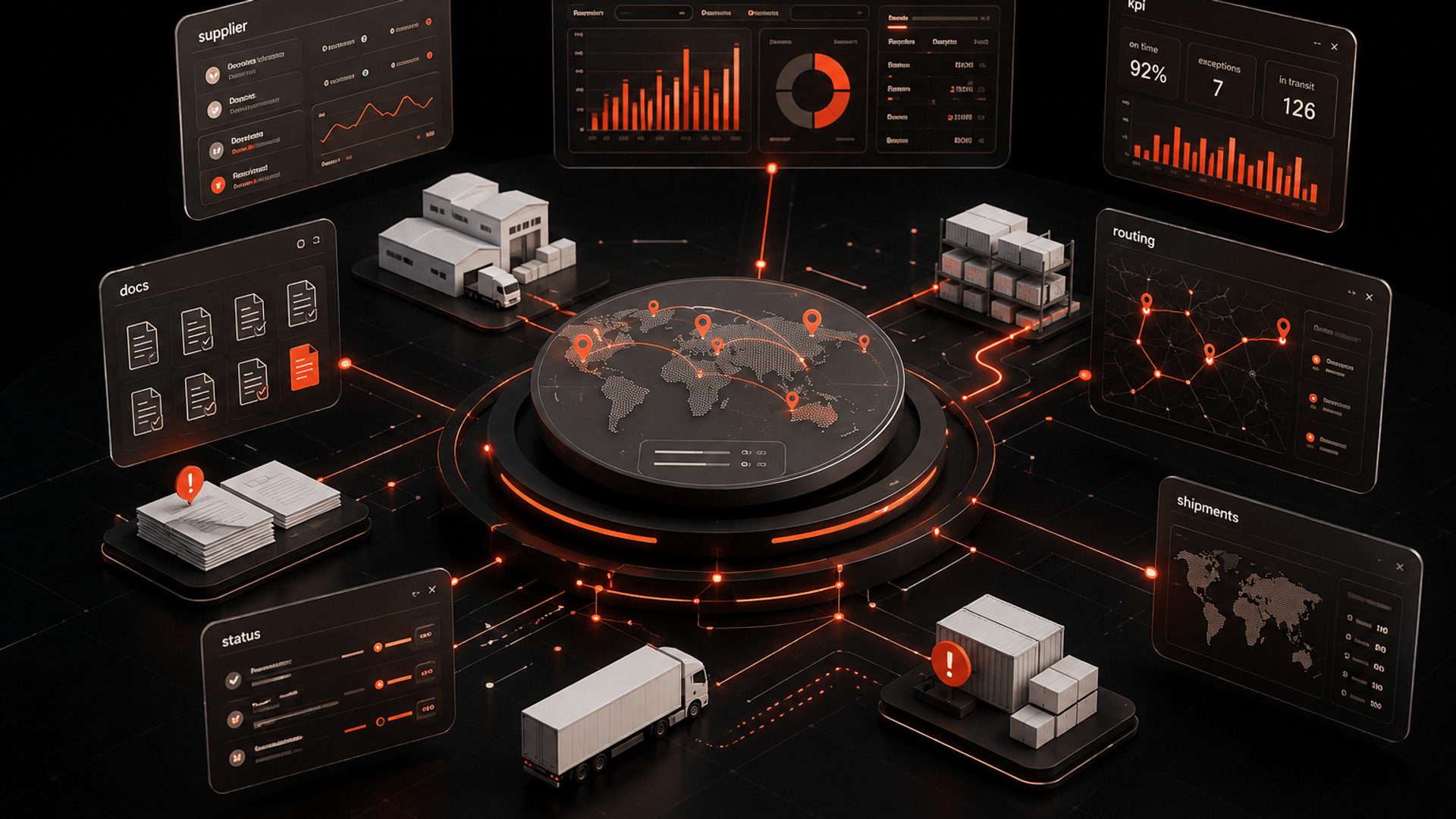
That is why supply chain workflow automation matters. AI is not most valuable when it simply drafts a message or summarizes a status report. It is more valuable when it acts as a coordination layer that sees the exception, understands the likely owner, gathers the right context, and routes the case before the delay compounds.
This is also why many companies are moving toward more agentic systems. The direction of the market is clear: AI is shifting from finding information to getting work done. In operations, that means moving from static reporting to workflow orchestration.
How AI changes supply chain workflows
The best way to think about this shift is not “AI replaces the team.” It is “AI changes the shape of the workflow.”
Today, a coordinator often does four jobs:
- Detects exceptions
- Collects context
- Routes decisions
- Follows up until closure
AI can support each of these steps in a different way.
1. Detect exceptions earlier
AI can monitor signals across systems and surface anomalies that a human would miss in a busy day. That might include:
- shipment ETA changes
- partial receipts
- PO and invoice mismatches
- repeated vendor delays
- inventory risk tied to specific SKUs or lanes
The value is not just visibility. It is earlier action.
2. Gather context automatically
Once an exception appears, AI can pull the related records together: order history, vendor performance, carrier notes, customer impact, and prior resolution patterns.
That reduces the time spent searching across tools and asking the same questions in Slack or email.
3. Route the right decision to the right person
This is where the coordination layer becomes powerful. AI can determine whether an issue belongs with procurement, logistics, warehouse ops, finance, or customer support. It can route by issue type, business rules, SLA, geography, or account priority.
4. Keep work moving
AI can draft the message, create the task, update the ticket, and remind the owner if the case stalls. In other words, it can preserve momentum across handoffs.
That is the practical future of ai workflow consulting in operations: not a single chatbot, but a system design problem around routing, exception handling, and decision support.
A practical framework for implementing AI in supply chain coordination
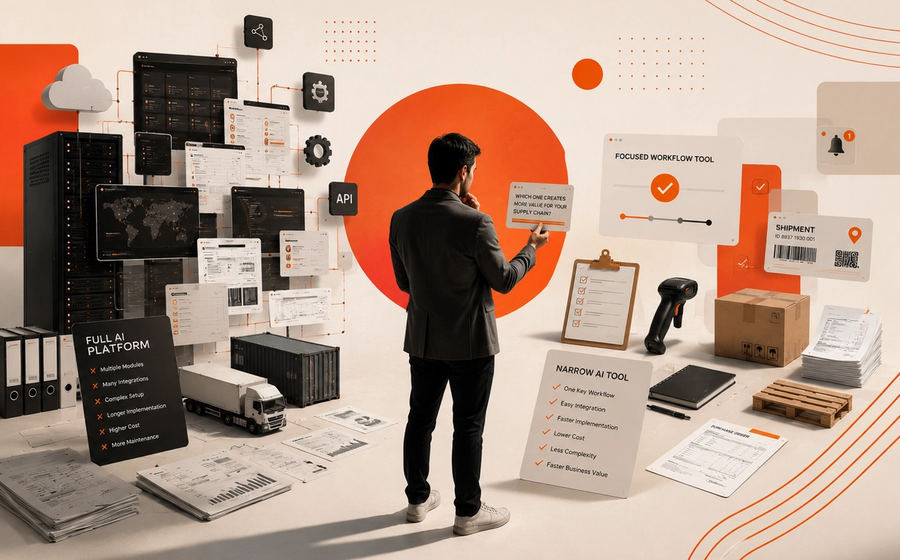
If you are evaluating ai use cases for business, do not start with the broadest workflow. Start with the one that creates repeatable friction and measurable delay.
Use this five-step framework.
Step 1: Pick one exception type
Choose a workflow where exceptions are common and painful. Good starting points include:
- late inbound shipments
- inventory discrepancies
- vendor document gaps
- order holds
- customer escalation from fulfillment issues
The right use case has clear rules, clear owners, and a visible cost when work slows down.
Step 2: Map the current handoffs
Write down exactly what happens when the exception appears.
Ask:
- Who notices it first?
- What systems are checked?
- Who approves the next step?
- Where does the work stall?
- What is copied manually?
This exercise usually reveals that the real bottleneck is not the decision itself. It is the transfer of context between people and tools.
Step 3: Define the AI role
Do not ask AI to “manage supply chain operations.” That is too broad.
Instead, define one role:
- classify the exception
- extract the relevant context
- recommend the next owner
- draft the first response
- create and track the task
- escalate when timing thresholds are missed
This keeps the system bounded and makes governance easier.
Step 4: Connect to the systems you already use
The goal is not to replace your stack. It is to improve the coordination between systems.
That usually means integrating with:
- ERP
- WMS
- TMS
- ticketing systems
- email and chat
- shared operational spreadsheets or trackers
A good implementation should sit between systems, not on top of them as another dashboard no one checks.
Step 5: Measure the workflow, not the model
The business value comes from operational change. Track metrics such as:
- time to detect an exception
- time to route to the right owner
- time to resolution
- number of handoffs per case
- percentage of cases resolved without escalation
- backlog age for open issues
If the numbers improve, the automation is working. If they do not, the AI is probably adding noise instead of clarity.
What this means in practice
In practice, AI will not make supply chains “fully autonomous” anytime soon. But it will make them more coordinated.
That changes the operating model in a few important ways.
First, coordinators spend less time assembling information and more time handling judgment calls. That is a better use of human effort.
Second, managers get fewer surprise delays because exceptions surface earlier and with more context.
Third, teams can handle more variability without adding as many manual coordinators. That matters in a market where supply chains are dealing with demand swings, supplier instability, labor constraints, and tighter response windows.
For developers, this is also a useful design space. The architecture is usually manageable: event triggers, policy rules, structured extraction, workflow routing, human approval points, and audit logs. The hard part is not model access. It is designing a dependable workflow.
For business owners, the lesson is simple. The first strong AI use case in operations is often not the most glamorous. It is the one that removes the most expensive friction in handoffs.
That is why the right entry point is often a focused implementation of ai automation for operations rather than a broad transformation program. If you need help scoping that path, Kumi Studio’s AI Automation Services are built for real workflow design, not generic experimentation.
Key takeaways
- Supply chain delays often start in the coordination layer, not the core execution systems.
- AI is most useful when it detects exceptions, routes decisions, and keeps work moving across handoffs.
- The best first use case is a narrow, high-friction workflow with clear owners and measurable resolution time.
Related reading
If you are exploring where AI can remove friction from operations without a major systems overhaul, Kumi Studio can help you map the workflow, design the automation, and move from idea to working system.