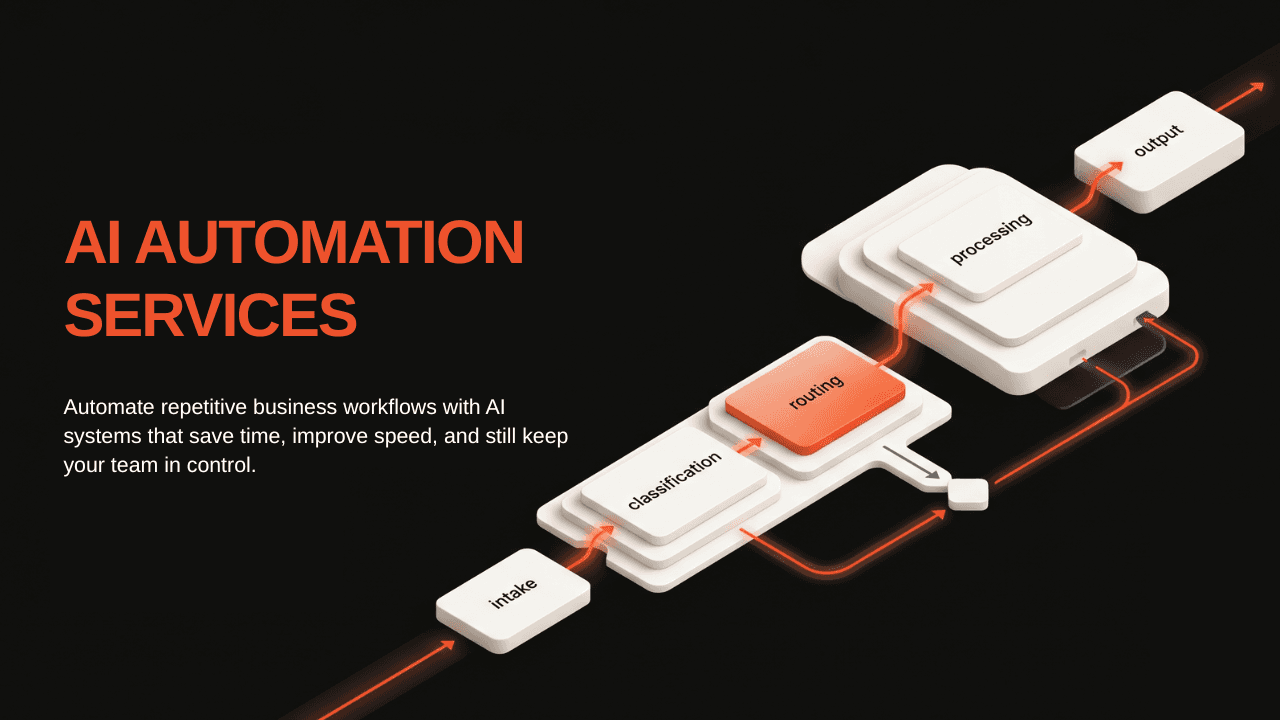
Automate repetitive business workflows with AI systems that save time, improve speed, and still keep your team in control.
What are AI automation services for logistics?
AI automation is not just a chatbot or a simple task runner.
It is the use of AI inside a workflow so the system can:
- understand inputs
- make limited decisions
- route work intelligently
- handle exceptions
- support human review when needed
That makes AI automation useful for real business processes that involve documents, messages, internal knowledge, structured steps, and decisions that are too variable for simple rules alone.
At Kumi Studio, AI automation services focus on workflows that are operationally meaningful. We help businesses improve the parts of work that are repetitive, slow, fragmented, or dependent on too much manual coordination.
Where does AI automation create the most value in supply chain?
The best automation opportunities are usually not abstract AI projects. They are specific business workflows with clear friction.
Common examples include:
- customer support ticket triage and routing
- lead intake and qualification
- internal knowledge retrieval and response drafting
- document processing and exception handling
- reporting and data movement across systems
- approval-heavy internal processes
- finance and operations workflows with repeated manual review
These are the kinds of workflows where AI can reduce handoffs, improve consistency, and help teams move faster without removing operational control.
What do Kumi Studio AI automation services include?
Workflow discovery and process analysis
We start by understanding the real process, not just the task. That means mapping inputs, outputs, bottlenecks, decision points, approvals, and exception paths. A strong automation project begins with workflow clarity.
AI automation strategy
We identify where AI should be used, where traditional automation is enough, and where human review still belongs. This prevents teams from overcomplicating workflows that could be solved more simply.
Automation design
We define the system structure required for the workflow, including:
- input handling
- decision logic
- integrations
- fallback paths
- review steps
- auditability
This is where workflow automation becomes real instead of conceptual.
Implementation and integration
We help implement the solution across the systems your business already uses. That may include CRMs, support platforms, internal tools, communication channels, knowledge systems, or custom operational software.
Optimization and scaling
After launch, AI workflows should improve over time. We help refine prompts, logic, routing, review thresholds, and integration behavior so the workflow performs reliably under normal business conditions.
How is AI automation different from traditional automation in logistics?
Traditional automation works best when the process is fixed and predictable.
AI automation helps when the workflow includes variability, language, documents, judgment support, or unstructured inputs. It can classify, summarize, extract, route, draft, and support decisions in ways that rule-based tools cannot handle cleanly on their own.
That said, not every process needs AI.
One of the most important parts of our work is deciding where AI adds value and where simpler automation is the better answer. The wrong kind of automation increases complexity. The right kind makes work easier to run.
How does Kumi Studio approach AI workflow automation?
1. Start with the business workflow
We look at how work moves today, where it gets delayed, which steps are repetitive, and what causes manual overhead.
2. Identify the right automation point
Some workflows benefit from AI at the intake layer. Others need AI for classification, routing, summarization, or exception handling. We determine where intelligence actually improves the process.
3. Design around operations, not demos
A useful automation system needs approvals, error handling, integrations, and escalation paths. We design for the operating environment, not idealized product demos.
4. Keep humans in the right places
Good automation does not remove people from every step. It removes them from the wrong steps and keeps them where judgment, approvals, and exception review still matter.
5. Build for measurable outcomes
The point of automation is not novelty. It is business improvement. We structure the workflow to reduce time, improve consistency, and make operations easier to manage.
Why choose Kumi Studio for AI automation?
Kumi Studio combines workflow thinking, implementation awareness, and AI system design.
That matters because most automation problems are not really model problems. They are workflow design problems. The hard part is not just generating output. It is deciding how the output fits into a larger process, what happens when something goes wrong, and how the system connects to the rest of the business.
Businesses work with us because they want:
- practical AI automation guidance
- better workflow design
- technically credible implementation thinking
- systems that fit real operations
- a partner who understands both business needs and AI execution
Which logistics workflows can Kumi Studio automate with AI?
Customer support automation
AI can classify tickets, suggest responses, route complex cases, retrieve policy information, and reduce time spent on repetitive support work.
Sales workflow automation
AI can qualify inbound leads, draft outreach, summarize call notes, enrich records, and keep sales teams focused on higher-value work.
Internal operations automation
AI can support intake workflows, internal request handling, reporting steps, and process coordination across departments.
Document and knowledge workflows
AI works well where teams deal with policies, documents, forms, extracted information, or internal knowledge spread across systems.
Multi-step workflows with exception handling
Some of the strongest automation opportunities are processes where work needs to move through several steps, systems, and review points. These are often ideal for a custom AI automation approach.
What does AI automation mean in practice for logistics teams?
In practice, the strongest automation projects do three things well:
1. reduce repetitive manual work
2. preserve operational control
3. fit naturally into the team's existing workflow
That is the difference between automation that gets adopted and automation that gets ignored.
If your team is still copying information between systems, triaging work manually, rewriting the same responses, or spending too much time on routine internal processes, there is likely an opportunity to automate meaningfully.
The real question is not whether AI can be used. It is where it should be used first.
What are the key takeaways on AI automation for logistics?
- AI automation works best when it is tied to a clear workflow problem.
- The right solution often combines AI, integrations, business rules, and targeted human review.
- Workflow fit matters more than tool novelty when building automation that lasts.