A model that is better at long, complex tasks is not just a model update. It changes how teams should think about automation.
Anthropic says Claude Fable 5 performs especially well on harder knowledge work, software engineering, vision, and research tasks, with its advantage growing as the task gets longer. That matters because most business workflows are not one-shot prompts. They are sequences: gather data, check exceptions, draft output, route for review, and hand off to a human. The core thesis is simple: Claude Fable 5 matters less as a benchmark win and more as a signal that AI is getting closer to dependable multi-step workflow execution.
For business owners, operators, and developers, the question is no longer “Can AI do the task?” It is “Can AI stay on task through all 20 steps without breaking the process?”
What changed in Claude Fable 5
Anthropic framed Fable 5 as a Mythos-class model made safe for general use. In plain English, that means the company is positioning it as a stronger general-purpose model, but with safeguards strong enough for public release.
The important shift is not just raw capability. It is task endurance.
According to Anthropic, Fable 5 stands out most on longer and more complex work. That suggests progress in three areas that matter directly for business automation:
- following multi-step instructions more reliably
- keeping context across longer workflows
- handling work that mixes text, code, vision, and research
This is the kind of improvement that changes how teams design systems. Earlier model generations often looked good in demos but failed in production because they lost context, skipped a step, or needed too much babysitting. If the latest AI model updates make the model more stable across longer work, then more workflows become candidates for automation.
That is the real answer to “what AI model release means for business.”
Why long-horizon reasoning matters more than benchmark headlines
Most operators do not buy AI because it scores well on tests. They buy it because they want fewer manual handoffs, faster resolution times, and less repeated work.
Long-horizon reasoning is the ability to stay coherent across a chain of decisions. That is different from answering a single prompt well.
Think about common business processes:
- resolving a customer support issue that needs account history, policy checks, and escalation
- qualifying a lead with multiple data sources and edge-case rules
- reviewing a warehouse exception report and routing it to the right team
- preparing a sales proposal using product docs, pricing rules, and legal constraints
- debugging a software issue across logs, code, and documentation
These are not “write me an email” tasks. They are workflow tasks.
When a model gets better at extended reasoning, the business opportunity expands from content generation to process execution. That is why this release belongs in the conversation about agentic AI updates. It is not only about smarter answers. It is about whether AI can function as a usable layer inside a real operating system.
What this means in practice for automation design
The most practical impact of Fable 5 is that it reduces friction in workflows that used to be too brittle for full automation.
But that does not mean you should remove humans and hope for the best. It means you can redesign the workflow around stronger model behavior.
Here is the implementation lesson:
1. Break the workflow into decision points
Do not ask the model to “do everything.” Instead, define stages:
- intake and classification
- information gathering
- rule-based checks
- draft output
- human approval
- execution or handoff
This structure makes failures visible. It also lets you decide where the model can operate independently and where it must stop.
2. Assign risk by step, not by workflow
Some steps are safe to automate. Others are not.
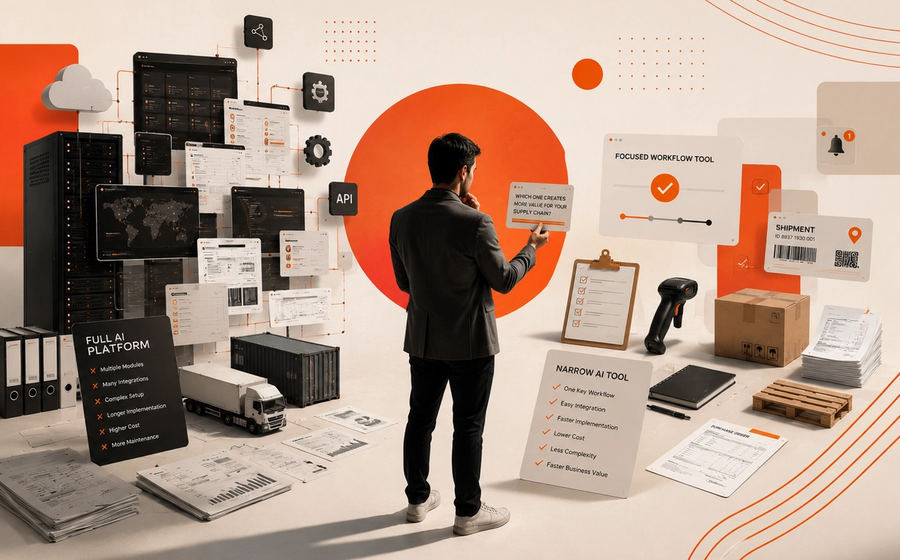
For example, a model may be fine to summarize a warehouse exception, but not fine to approve a shipment override. It may draft a contract response, but not send it without review.
Strong reasoning improves step quality, but it does not erase operational risk. The right question is not whether the model is “good enough overall.” It is whether each step has the correct control level.
3. Use human review where the cost of error is high
As models get better, teams often make a mistake: they remove review too early.
The better move is to keep human approval at the point where business risk is highest. In many cases, that is after the model has done the hard work of collecting information and drafting a recommendation.
This is where AI becomes useful in practice. It cuts labor without cutting judgment.
4. Measure workflow success, not prompt quality
If you are evaluating latest AI model updates, do not just test whether the output sounds better.
Measure:
- task completion rate
- number of manual corrections
- time to resolution
- escalation frequency
- error severity
- approval latency
That is how teams decide whether a model is ready for production use.
A simple framework for teams evaluating Claude Fable 5
If you are asking whether this release changes your automation roadmap, use this framework.
Step 1: Identify the multi-step work
Look for tasks that include three or more stages, such as intake, interpretation, drafting, and approval.
Good candidates usually have:
- repeated patterns
- clear rules
- enough context for a model to use
- a measurable business outcome
Step 2: Separate routine from sensitive actions
Mark the points where AI can assist versus act.
A model can often:
- summarize
- classify
- draft
- compare options
- flag exceptions
A model should usually not:
- approve money movement
- change records without review
- trigger customer-facing commitments
- make final policy calls in edge cases
Step 3: Add checkpoints
Insert control points where a human or system verifies the output before the next step begins.
This is especially important in operations, finance, logistics, and software release workflows. More capable reasoning helps the model move through the process, but checkpoints keep the process safe.
Step 4: Pilot one workflow, not ten
Pick one process where the pain is obvious and the stakes are manageable.
A good first pilot often sits in the middle of complexity:
- too hard for simple automation
- not so critical that one mistake is catastrophic
That is where a model like Fable 5 can show value without creating unnecessary risk.
If your team is ready to test this kind of design, Kumi Studio’s AI Consulting Services can help you map the process before you build it: AI Consulting Services.
What this means in practice for business teams
For small businesses, this release does not mean “replace the team with agents.” It means the cost of structured automation may come down in areas that were previously too messy for a clean shortcut.
That has three practical effects.
First, teams can automate more of the work between people, not just the work done by people.
Second, developers can spend less time patching fragile prompt chains and more time designing control logic, fallback paths, and review rules.
Third, operators can build workflows that reflect how the business actually runs, rather than forcing everything into a single prompt-response pattern.
This is especially relevant in environments like logistics, customer operations, procurement, and internal service desks, where the job is not a single answer but a sequence of judgments.
If you are already exploring process automation, the next step is not a broad AI rollout. It is a workflow audit. Find the tasks that break when they become multi-step. Those are the best candidates for a more capable model.
For teams that want help turning that into a real system, Kumi Studio’s AI Automation Services are built for implementation: AI Automation Services.
Key takeaways
- Claude Fable 5 matters because it improves the case for multi-step AI automation, not because it is just another model launch.
- The biggest business impact is on workflows that need context, sequencing, and review, not on simple one-prompt tasks.
- Teams should redesign around checkpoints, human approval, and measurable workflow outcomes instead of chasing benchmark headlines.
Related reading
If you are evaluating what this release means for your workflows, Kumi Studio can help you decide where AI fits, where humans should stay in the loop, and how to build automation that works in production. Start with a conversation via Contact Kumi Studio.