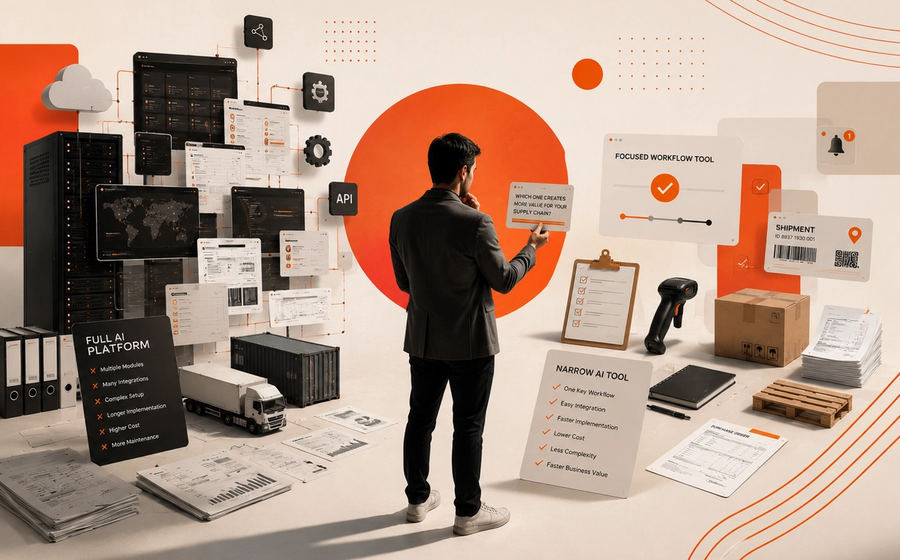
A delayed shipment, a missed customs document, and a late warehouse handoff can all trigger the same expensive pattern: someone notices the issue, emails three people, waits for a reply, and loses another hour. In many supply chains, the problem is not a lack of data. It is a lack of coordination.
That is where AI automation for operations is starting to matter. The biggest value is not simply better forecasting. It is a coordination layer that detects exceptions early, classifies what they mean, routes them to the right owner, and keeps the workflow moving without inbox chasing. For business owners, operators, and developers, that shift changes how supply chain teams work day to day.
In this post, we will look at how supply chain AI automation can move control towers from manual follow-up to exception-led coordination, where value appears first, and what a practical implementation path looks like.
Why the control tower breaks down in real life
Most supply chain control towers were built to improve visibility. They centralize status updates, shipment milestones, inventory signals, and alerts. That helps, but visibility alone does not resolve the work.
The bottleneck is usually the handoff after an exception appears.
A few common examples:
- A supplier confirms a delay, but no one updates the customer promise date.
- A customs issue is logged, but the compliance owner is not notified fast enough.
- A carrier exception is visible in a dashboard, but the planner still has to chase operations by email.
- A stockout risk is identified, but the purchasing team and warehouse team do not act on the same version of the issue.
These are workflow problems, not analytics problems. They persist because the exception is scattered across systems and people.
This is why many teams see limited ROI from dashboards alone. The data is there, but the coordination layer is missing. AI changes that by turning signals into action.
The real opportunity: make exceptions routable, not just visible
The strongest use cases for AI in supply chain operations are not “AI predicts demand.” They are operational workflows where AI can decide what an exception is, who should handle it, and what should happen next.
Think of the workflow in four steps:
- Detect the exception from emails, ERP updates, carrier feeds, or ticketing tools.
- Classify the issue by type, urgency, lane, customer impact, and likely root cause.
- Route it to the right owner with the context they need.
- Track resolution until the next action is complete.
That is the shift from manual follow-up to exception-led coordination.
This is also why platform changes from vendors such as Google Cloud and AWS matter. The market is moving toward agentic systems that can work across tools, not just generate text. The point is not to add another dashboard. It is to let AI carry parts of the coordination workload in a secure, governed way.
For leaders evaluating ai use cases for business, this is a strong pattern because it maps directly to cost, service, and team efficiency.
Where AI creates value first in supply chain operations
Not every workflow should be automated at once. The first wins usually come from exceptions that are frequent, structured enough to classify, and painful enough that delay costs money.
Start with these areas:
1. Order exceptions
Late orders, partial fills, backorders, missing approvals, and incorrect promised dates are often handled through email threads. AI can pull in the order context, identify the exception type, and create a clean task for the right team.
2. Transportation exceptions
Missed pickups, route changes, carrier delays, and document issues are ideal for automated triage. AI can read status feeds, flag urgency, and notify the planner before the delay spreads.
3. Inventory and replenishment exceptions
When inventory crosses a threshold, AI can check whether the issue is a true shortage, a forecasting gap, or a receiving delay. That avoids unnecessary escalation and helps the team focus on the real cause.
4. Supplier coordination
A supplier exception may require procurement, quality, and operations to act together. AI can package the issue with the right evidence, assign the next owner, and keep a shared record of decisions.
5. Customer-impacting escalations
When a delay affects a major customer, the system should not just alert someone. It should gather status, suggest next actions, and route the case with urgency.
This is where supply chain ai automation often produces the clearest business value first: fewer missed handoffs, faster escalation, and less time spent assembling context manually.
A practical framework for exception-led coordination
If you are planning ai workflow consulting or internal automation work, use this implementation frame.
Step 1: Map the exception flow
Pick one workflow, not the whole supply chain. Trace how an exception is detected, who sees it, how it is triaged, and where it gets stuck.
Look for:
- repeated email follow-up
- duplicate manual entry
- unclear ownership
- slow escalation
- inconsistent resolution notes
Step 2: Define the decision points
AI does not need to own every decision. It should handle the decisions that are repetitive and rules-based enough to trust.
Examples:
- Is this exception urgent?
- Which team should own it?
- What information is missing?
- Does this need human approval?
- What is the recommended next action?
Step 3: Connect the operational systems
The workflow should pull from the tools teams already use: ERP, WMS, TMS, ticketing systems, shared inboxes, and messaging platforms.
This is where implementation quality matters. Good automation is less about model choice and more about reliable data access, workflow design, and governance.
Step 4: Add human checkpoints
The best systems do not remove people. They reduce the time people spend searching, sorting, and chasing.
Use human review for:
- high-value shipments
- customer-facing changes
- compliance-sensitive decisions
- low-confidence classifications
Step 5: Measure workflow outcomes
Do not measure the project by model accuracy alone. Measure:
- time to triage
- time to resolution
- percentage of exceptions routed correctly
- number of manual follow-ups removed
- delay reduction in critical workflows
This is how ai automation for operations becomes a business case instead of a technology demo.
What this means in practice
In practice, the control tower becomes less like a passive monitoring center and more like an active coordination engine.
A planner no longer starts the morning by scanning 12 tabs and three inboxes. Instead, the system surfaces the exceptions that matter, adds the relevant context, and opens a clean action path. A customer service lead sees the shipment delay before the customer calls. A procurement manager gets a structured exception with supplier history attached. A developer can extend the workflow with rules, API calls, and approval logic instead of building a custom interface from scratch.
That is the real workflow change.
It also changes the economics of operations work. Teams spend less time on “where is this case?” and more time on “what decision should we make?” That distinction is important because it is often where ROI appears first: not in headline transformation, but in fewer delays, less firefighting, and better handoff reliability.
For companies exploring ai use cases for business, this is one of the clearest examples of AI moving from content generation into operational execution.
If you are defining a roadmap, Kumi Studio’s AI Automation Services can help identify the workflows where coordination gains are realistic, not speculative. For broader planning, AI Consulting Services can help teams decide where to start and what to sequence next.
Key takeaways
- The biggest supply chain AI opportunity is not better prediction alone; it is faster exception coordination.
- Start with workflows that have frequent handoffs, clear ownership, and measurable delay costs.
- Measure ROI through triage time, resolution time, routing quality, and fewer manual follow-ups.
Related reading
Closing thought
Supply chains do not need more noise. They need better coordination.
The companies that win with AI will not be the ones that only forecast more accurately. They will be the ones that redesign how exceptions move through the business, so work gets routed faster and decisions do not disappear into email.
If you are looking at ai automation for operations and want to identify the first workflow worth fixing, Kumi Studio can help you map it, design it, and implement it in a way your team can actually use. Contact us.