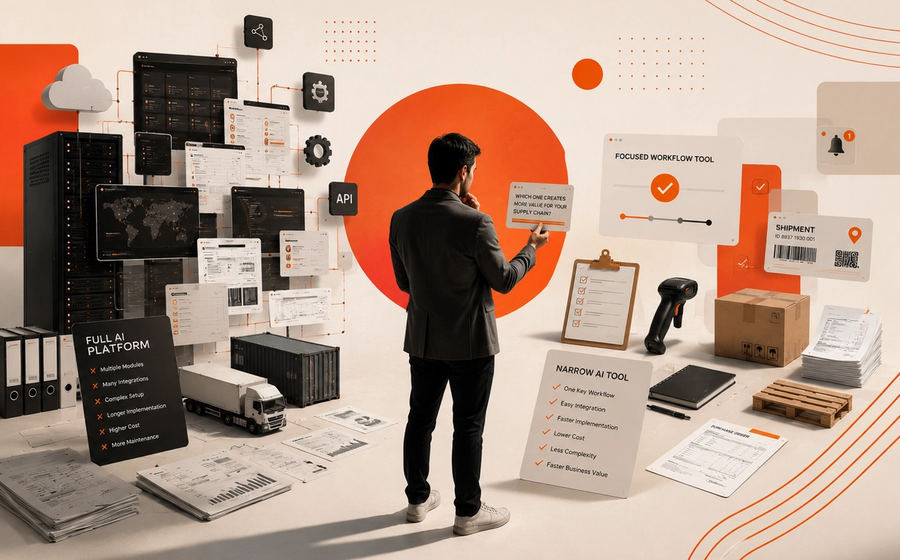
A supply chain leader sees a demo of an AI agent that can read emails, flag exceptions, and draft responses to suppliers. It looks fast, polished, and useful. The temptation is to buy it now and figure out the process later.
That is the mistake.
For supply chain operations, the first question is not whether an agentic AI product can act. It is whether your team has an operating model that can absorb those actions safely. Business teams should test workflow fit, governance, escalation, and ownership before they adopt any new AI product. Otherwise, the tool may automate confusion instead of improving performance.
This is the contrarian view: evaluate agentic AI tools as operating-model decisions first and software decisions second. That matters now because AI product updates are arriving faster than most teams can define who approves exceptions, who owns outcomes, and what happens when the model is wrong.
Why the demo is the wrong starting point
The current wave of agentic AI products is designed to do more than answer questions. They can propose decisions, trigger workflows, and move work across systems. In supply chain terms, that means they can touch procurement, inventory, logistics, forecasting, and supplier communication.
That is powerful. It is also risky.
A demo usually shows the best-case version of the tool:
- clean data
- a narrow use case
- a controlled workflow
- no edge cases
- no cross-functional conflict
Real supply chain operations are the opposite. They are messy, conditional, and dependent on human judgment. A late shipment may affect customer service, warehouse labor, vendor terms, and finance. An AI agent can help coordinate that complexity, but only if the workflow is already designed for it.
This is why so many teams get excited by the category but struggle in production. They buy an impressive interface before they define the process behind it.
The better question is: what decision does the AI make, who is accountable for it, and what system proves it was right?
The operating model test: 5 questions before you buy
If you are evaluating agentic AI tools, use this simple filter before procurement moves forward.
1. What decision is the tool actually making?
Be specific. “Improving supply chain efficiency” is not a decision. “Escalating a delayed shipment to the regional planner” is.
You need to know whether the product:
- recommends
- drafts
- routes
- executes
- or closes the loop autonomously
Each step raises the level of risk and the level of process maturity required.
If the vendor cannot describe the decision in plain language, the product is not ready for your operation.
2. Who owns the outcome when the AI is wrong?
Every automated workflow needs a named owner. Not a team. Not a department. A person or role.
Ask:
- Who reviews exceptions?
- Who can override the agent?
- Who is accountable for missed SLAs?
- Who explains the decision to suppliers or internal stakeholders?
If ownership is vague, the system will create shadow work. People will quietly fix errors without documenting them, and the business will think the tool is working when it is actually shifting labor around.
3. What data can the agent access, and what should it never touch?
Agentic AI tools are only useful if they can act in context. But access must be deliberate.
Supply chain workflows often involve sensitive data such as pricing, contracts, supplier performance, and customer commitments. A useful tool is not one with the broadest access. It is one with the right boundaries.
Test for:
- role-based permissions
- audit logs
- approval thresholds
- data lineage
- secure handoffs to existing systems
If the product cannot show how it protects decisions, it is not enterprise-ready.
4. What happens when the workflow breaks?
Every supply chain process has exceptions. A supplier changes terms. A forecast is outdated. A shipment is split. A system is down.
A good AI product should not just handle the happy path. It should show how it behaves when the path changes.
Look for:
- fallback rules
- human escalation paths
- retry logic
- exception queues
- auditability after the fact
This is where many best ai tools for business fail in practice. They work in ideal conditions, then become brittle when operations get real.
5. Can the workflow be improved without the agent?
This is the most important test.
If the answer is no, your team may be trying to use AI as a substitute for process design. That usually produces a weak implementation.
Before buying, map the current workflow without AI:
- where does work start?
- where does it wait?
- where are the handoffs?
- where do decisions stall?
- where do people manually re-enter the same information?
If the workflow is already unclear, an agent will not fix it. It will simply move the confusion faster.
What this means in practice
The smartest supply chain teams do not start with “Which agent should we buy?” They start with “Which workflow is ready for partial automation?”
That distinction changes the buying process.
Here is the practical sequence:
- Pick one narrow workflow. Start where decisions are frequent but bounded, such as supplier follow-up, exception routing, or status summarization.
- Document the current operating model. Write down who does what, when approvals happen, what systems are involved, and what counts as success.
- Define the human handoff. Decide what the AI can do alone, what it can recommend, and what must always go to a person.
- Test failure cases first. Ask the vendor to show what happens when data is missing, confidence is low, or the decision conflicts with policy.
- Measure business impact, not activity. Do not measure how many actions the agent took. Measure cycle time, exception quality, response speed, and labor saved on repetitive work.
This is also where many teams need help from an implementation partner. A credible AI consulting team can help you separate the workflow problem from the software pitch, and decide whether the use case is ready for automation at all.
A better buying guide for agentic AI tools
If you want a simple rule, use this one:
Buy the workflow before you buy the agent.
That sounds backwards in a market full of product demos. But it is the right way to reduce risk and increase ROI.
An agentic AI tool is not just another SaaS app. It is a decision layer inside your operating model. That means your evaluation should include operations, legal, security, finance, and the people who will live with the output every day.
For developers, this also changes the build-vs-buy question. A strong product may solve the interface problem, but your team may still need custom integrations, exception handling, and governance logic. In those cases, AI development may be the better path if the workflow is specific to your business.
The most valuable AI product updates are not the ones with the flashiest demo. They are the ones that fit a real process, respect control points, and make the organization faster without making it less accountable.
Key takeaways
- Agentic AI in supply chain is an operating-model choice first, a software choice second.
- If you cannot define ownership, escalation, and failure handling, do not buy yet.
- The best first use case is a narrow workflow with clear decisions and measurable outcomes.
Related reading
If your team is evaluating agentic AI tools and wants a practical view of what will work in your operating environment, Kumi Studio can help you test the workflow, define the controls, and build the right system. Start with AI consulting, then move into development only when the process is ready.