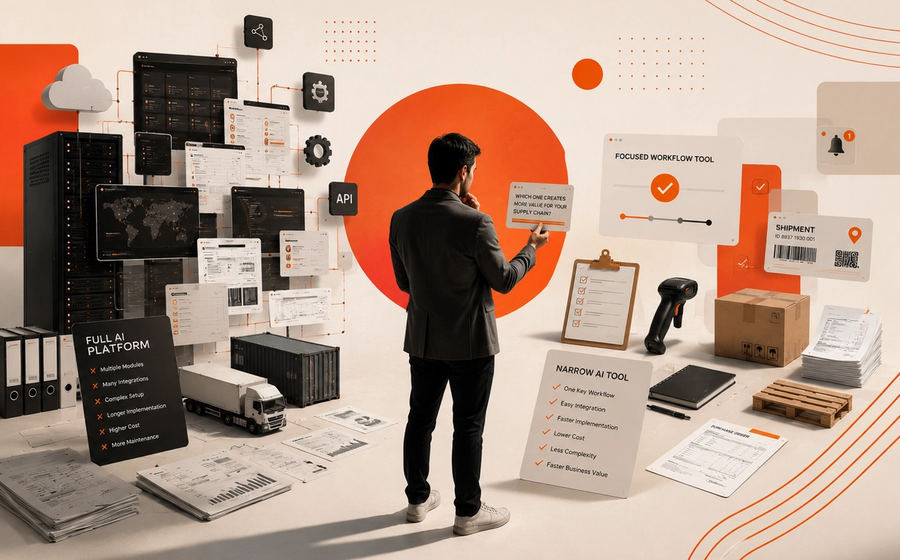
A logistics team that once needed a larger, more expensive model to build a useful AI agent can now likely do the same work with a smaller one. That is the real shift behind Claude Sonnet 5. Anthropic says the model is stronger at reasoning, tool use, coding, and professional work, while closing the gap on its larger Opus class models at a lower cost.
For business owners, operators, and developers, that matters because the bottleneck is no longer just model quality. It is whether AI can be deployed in real workflows without blowing up cost, latency, or operational complexity. The thesis here is simple: Claude Sonnet 5 matters less because it is a better chatbot and more because it makes agentic workflows more practical to deploy at business scale.
If you are tracking the latest AI model updates, this release is worth paying attention to not as hype, but as a signal about what automation can now look like in everyday operations.
Why this update matters now
Most companies do not need a model that wins abstract benchmarks. They need systems that can read instructions, use tools, follow steps, and finish work with enough reliability to be operationally useful.
That is why the Sonnet 5 release is important. Anthropic is positioning it as its most agentic Sonnet yet, with improved reasoning, tool use, and coding. It also narrows the performance gap with larger models while staying lower cost. In plain English: tasks that previously felt “too expensive to automate with agents” may now be reasonable to pilot.
This is especially relevant in workflows that involve:
- pulling data from multiple systems
- checking exceptions against business rules
- drafting responses or summaries
- generating code, queries, or internal automations
- coordinating multi-step work across tools
For teams evaluating AI consulting or automation, this changes the decision from “should we wait for models to improve?” to “which workflows are ready to implement now?”
What changed in this model update?
The most important change is not just that Sonnet 5 is smarter. It is that it is more capable where business workflows actually break.
Anthropic says the model is better at:
- Reasoning: handling more complex, multi-step tasks
- Tool use: working with browsers, terminals, and other tools
- Coding: supporting developer workflows and implementation
- Knowledge work: assisting with professional tasks that require structure and context
It also says Sonnet 5 is closer to its larger Opus models than previous Sonnet releases, while costing less. That matters because many agentic systems fail on economics before they fail on intelligence. A workflow may work technically, but if every step requires a premium model, it becomes hard to justify at scale.
The second signal is safety and operational fit. Anthropic says Sonnet 5 shows fewer undesirable behaviors than Sonnet 4.6 and is safer to use in agentic contexts. For businesses, that does not remove the need for guardrails. But it does suggest the model is becoming more practical for controlled production use.
What this means in practice for operators
The best way to think about this release is through workflow design, not model comparison.
1. More workflows can move from assistive to semi-autonomous
A lot of companies are stuck using AI as a helper that drafts text but cannot complete tasks. Sonnet 5 pushes more use cases into the “can do the work with supervision” category.
Examples include:
- inbox triage and routing
- order exception handling
- document extraction and validation
- quote or proposal drafting from structured inputs
- internal knowledge lookup and response generation
- code generation for repetitive engineering tasks
The key shift is that the model is better suited for chained actions, not just single prompts.
2. Lower model cost expands the number of viable use cases
If a workflow only needs a larger model for one step, the whole system can get expensive fast. When a smaller model closes the gap, you get more room to automate lower-margin but high-volume tasks.
That matters in operations-heavy businesses where the economics are tight. A warehouse, logistics firm, or service business may not need “the best model.” It needs a model that is good enough to reduce handling time, cut rework, and free up staff for exceptions.
3. Reliability matters more than raw intelligence
In agentic systems, the model is only one part of the system. The real question is whether it can:
- follow policy
- use the right tools
- stop when confidence is low
- escalate exceptions correctly
- leave an audit trail
Sonnet 5 may raise the ceiling, but production value still depends on workflow design. This is where many teams misread latest AI model updates: they assume a better model eliminates the need for process design. It does not. It makes good process design more viable.
A practical framework: how to decide if Sonnet 5 changes your roadmap
Use this four-step test before you build anything new.
Step 1: Identify repetitive work with clear inputs and outputs
Look for workflows where the same pattern repeats every day or week.
Good candidates usually have:
- structured or semi-structured inputs
- clear business rules
- known exceptions
- a measurable output
- a human reviewer already in the loop
If the work is too ambiguous, it may still need human judgment. But if most of the task is routine, Sonnet 5 may now be strong enough to handle the middle of the workflow.
Step 2: Separate reasoning from risk
Not every task needs the same level of autonomy.
Ask:
- What part requires reasoning?
- What part is operational?
- What part is risky if wrong?
- What must always be reviewed by a human?
This lets you assign the model to the parts it can do well, while keeping controls around high-risk decisions. For example, an agent can draft a vendor response, but procurement approval still stays with a manager.
Step 3: Compare the workflow cost to the business value
Do not ask, “Can the model do it?” Ask, “Does the workflow justify being automated?”
A useful business case might include:
- time saved per task
- fewer handoffs
- lower error rate
- faster response time
- improved staff focus on exceptions
If the workflow is high-volume and repetitive, a lower-cost model can make the difference between a proof of concept and a real deployment.
Step 4: Design for supervision, not perfection
Agentic AI should be built with controls from the start.
That means:
- logging actions
- setting approval thresholds
- defining fallback steps
- limiting tool access
- testing edge cases before launch
This is where an experienced AI implementation partner matters. If you are evaluating AI consulting services, the goal should not be “make AI sound impressive.” The goal should be to design a system your team can trust.
What this means in practice
If you run operations, here is the most useful interpretation of the Sonnet 5 release.
For business owners, this is a sign that AI automation is getting more affordable to deploy beyond the pilot stage. The question is no longer whether agents are possible. It is which workflows create enough value to justify implementation.
For operators, this is an opportunity to revisit processes that were previously too fragile or too expensive to automate. Think of tasks with frequent exceptions, manual lookups, or repeated documentation.
For developers, this is a reminder that model choice is now a systems decision. The model should be selected based on workflow fit, tool access, monitoring, and cost—not just benchmark headlines.
For example, a logistics team could use an agent to read incoming shipment updates, compare them with delivery windows, flag exceptions, and draft customer notifications. A warehouse team could use a similar pattern to support inventory checks, vendor follow-ups, or SOP lookups. In both cases, the value comes from reducing manual coordination.
This is also why AI automation services matter more than isolated model testing. The business outcome comes from putting the model inside a process.
Key takeaways
- Claude Sonnet 5 is important because it makes agentic workflows more practical, not because it is just a better chatbot.
- Lower cost and stronger reasoning expand the number of business processes that can be automated with supervision.
- The winners will be teams that pair model capability with good workflow design, guardrails, and clear business cases.
Related reading
If you are deciding whether this model update changes your roadmap, Kumi Studio can help you translate it into a working workflow, not just a test. Contact us to explore where agentic AI fits in your operations.