
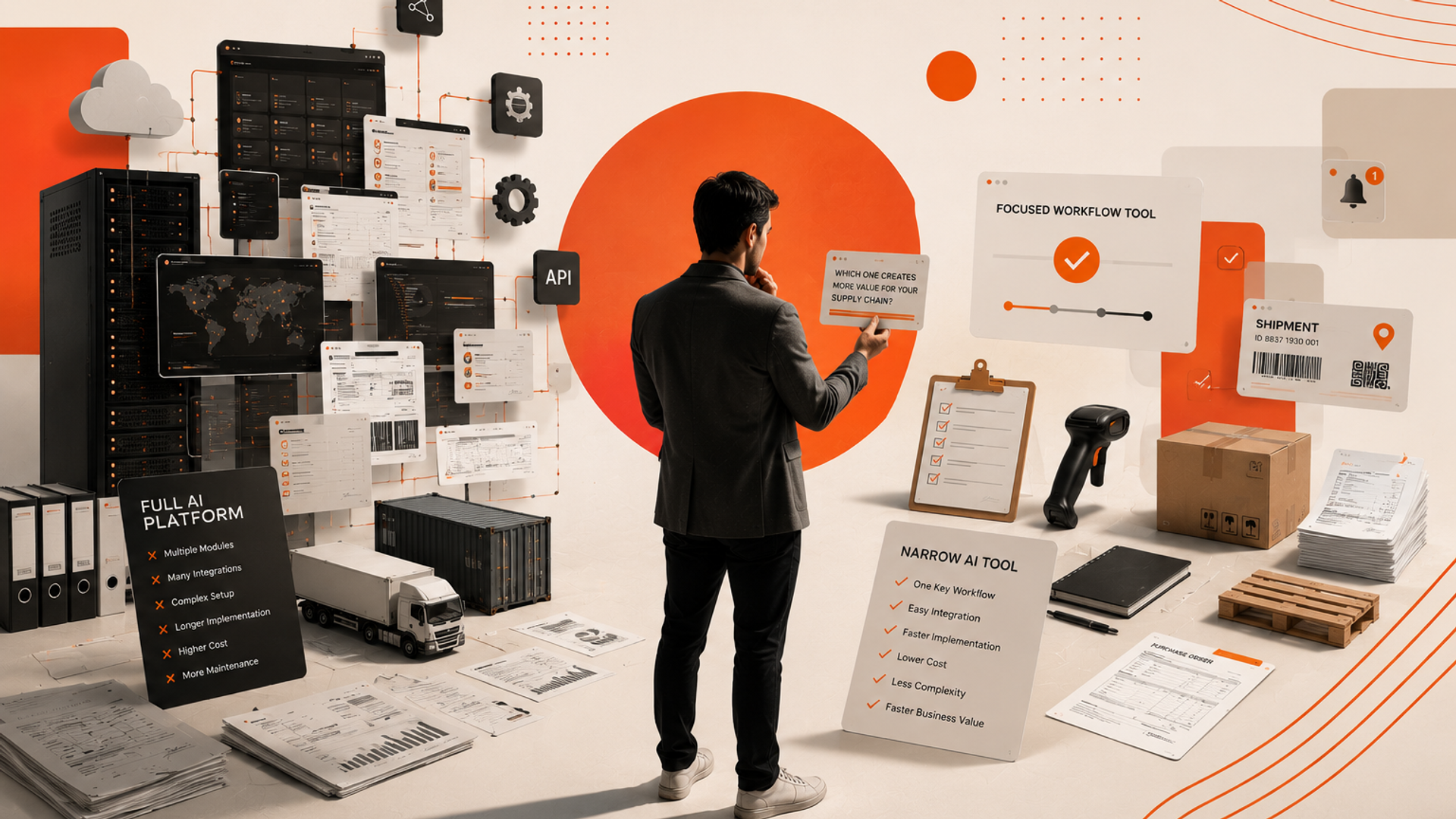
A familiar pattern is emerging in AI software. Large vendors are racing to offer end-to-end agent platforms. Google Cloud’s new Gemini Enterprise is a good example: one environment for models, orchestration, governance, and deployment. That sounds attractive, especially to operations leaders who want one secure answer.
But in supply chain operations, the safer buying decision is often the opposite.
If your team is comparing new AI tools, start by asking which product can improve one exception-heavy workflow fastest, with the least integration risk. In most cases, the best AI tools for business are not the broadest suites. They are narrower products that solve a specific operational problem cleanly, fit your current systems, and keep your future architecture open. That is the contrarian view, and for many teams, it is the better one.
Why the full-platform pitch is attractive, and why it often fails in operations
The case for a full AI platform is easy to understand.
A suite promises one vendor, one governance model, one user experience, and a path to scale. For CIOs and procurement teams, that sounds efficient. For developers, it can reduce tool sprawl. For executives, it feels safer than buying several smaller products.
The problem is that supply chain work rarely fails at the platform level. It fails inside specific process breaks.
A planner cannot reconcile a retailer promotion change with the demand baseline. A procurement team cannot compare supplier records across systems. A logistics coordinator loses time chasing exceptions across emails, PDFs, and ERPs. A quality team waits on compliance evidence buried in shared drives and inboxes.
These are not abstract “AI transformation” problems. They are workflow problems.
That is why broad platforms often underperform in early supply chain adoption. They give teams a lot of capability, but not enough process fit. And process fit matters more than model breadth in the first year.
Research and industry examples across CPG and electronics point to the same lesson: AI creates value when it sits inside the work people already do, with clear review points, data sources, and handoffs. It does not create value because a company bought the most complete platform.
The better comparison: platform breadth versus workflow fit
When business teams run an AI tool comparison, they often compare feature lists. That is the wrong starting point.
The better comparison is this:
Option A: a full platform
- Broad model access
- Agent orchestration
- Governance tools
- Developer framework
- Potentially stronger long-term standardization
Option B: a narrow product
- Focused on one workflow or use case
- Faster time to pilot
- Smaller implementation footprint
- Easier ROI measurement
- Lower switching cost if the process changes
In supply chain operations, Option B often wins first.
Why? Because most operations teams do not need a new AI estate on day one. They need one working improvement in a live process.
That could be:
- exception triage for inbound orders
- supplier document comparison
- inventory issue summarization across systems
- claims or deduction support collection
- forecast adjustment support with human review
- compliance evidence retrieval and validation
A narrower product is often worth more because it forces discipline. It must prove value in a specific step, not across a future roadmap. It must integrate with the systems your team actually uses, not the systems the vendor hopes you will modernize later.
That is a more useful ai software buying guide for operators than asking which suite has the most agentic features.
A practical framework for deciding what to buy
Here is a five-part framework for comparing AI tools for supply chain operations.
1. Start with one exception-heavy workflow
Pick a process with three traits:
- high manual effort
- repeatable decision logic
- frequent delays caused by fragmented data or documents
Good candidates are workflows where staff spend time gathering context before acting. That is where AI can reduce cycle time without removing human judgment.
Avoid broad goals like “improve planning with AI.” Instead define the workflow in operational terms: “help planners review promotion-driven forecast exceptions using sales history, retailer notes, and current constraints.”
2. Measure process fit before model sophistication
Ask:
- Does the tool fit the actual sequence of work?
- Can it read the documents, records, and system fields used in that process?
- Can a human review, approve, or reject the output at the right point?
- Does it preserve traceability?
If the answer is unclear, the tool is not ready, no matter how strong the demo looks.
In supply chain settings, the winning tool is often the one that handles messy inputs and review loops well, not the one with the most advanced autonomous agent claims.
3. Score implementation risk honestly
Most pilots fail for ordinary reasons:
- weak system access
- poor data mapping
- unclear ownership
- no reviewer workflow
- too much change for frontline teams
So compare tools on:
- integration effort with ERP, WMS, TMS, spreadsheets, and document stores
- security and permissions
- auditability
- fallback handling when confidence is low
- vendor flexibility if your process changes
A narrow tool with light integration and clear escalation rules may be lower risk than a suite that requires broader architecture decisions upfront.
4. Estimate ROI speed, not theoretical ROI
Many AI business cases look large in slides and small in practice.
A better test is: how quickly can this tool improve one measurable outcome?
Examples:
- reduced time to resolve exceptions
- fewer manual document reviews
- faster supplier response analysis
- shorter cycle time in claims handling
- improved planner throughput on high-variance items
This is why narrow products often outperform suites early. They are easier to tie to one metric, one team, and one owner.
5. Preserve architecture freedom
Do not let one purchase close future options too early.
Ask:
- Can this tool export outputs and logs cleanly?
- Can it sit alongside your existing systems without forcing a full stack change?
- If another model or workflow engine becomes better next year, can you adapt?
In a fast-moving market for agentic ai tools, lock-in is not only a pricing issue. It is a process design issue.
What this means in practice
For business owners, this means buying AI more like operational equipment and less like corporate software strategy. Start with the task where delay is expensive and manual work is persistent. Demand proof in that process before funding expansion.
For operators, it means writing the use case at the sub-process level. Map the trigger, inputs, system touchpoints, review step, and output. If the vendor cannot support that flow, the product is probably too generic for your environment.
For developers, it means resisting the urge to overbuild too early. A narrow tool can be the fastest way to learn what data quality, permissions, and orchestration issues actually matter. That learning is strategic. It can guide whether a broader platform makes sense later.
The practical next step is simple: run a bounded pilot on one live workflow with a named owner, a clear success metric, and a hard review point after 30 to 60 days.
If you need help shaping that evaluation, Kumi Studio’s AI Consulting Services are designed for exactly this kind of decision: turning AI interest into a scoped workflow, implementation plan, and realistic business case.
A buyer checklist for comparing new AI tools in supply chain operations
Use this checklist in vendor reviews.
Process fit
- What exact workflow does the tool improve?
- Where does human review happen?
- What exceptions can it handle well?
Data and systems
- Which systems does it connect to today?
- How does it handle PDFs, emails, spreadsheets, and unstructured records?
- What data prep is required from your team?
Implementation risk
- How long to pilot?
- What internal team support is required?
- What happens when the tool is uncertain or wrong?
ROI speed
- What metric should improve first?
- How quickly can you observe that change?
- Is the value direct and measurable, or broad and speculative?
Architecture flexibility
- Will this lock you into one stack?
- Can you swap models or extend workflows later?
- Are outputs portable?
This checklist sounds basic, but it is what separates useful buying from trend-driven buying.
Key takeaways
- The best ai tools for business in supply chain operations are often narrow products that solve one exception-heavy workflow well.
- A strong ai tool comparison should focus on process fit, implementation risk, and ROI speed more than platform breadth.
- Buy in a way that preserves future flexibility; prove one capability first, then decide whether a broader platform is justified.
Related reading
The market will keep moving toward bigger AI suites and more bundled agent platforms. That does not mean your team should buy that way.
In supply chain operations, the lower-risk move is often to buy less, learn faster, and keep your stack open. If you want help comparing tools, designing a pilot, or building the right workflow around a promising product, Kumi Studio can help you turn that decision into a working system.