
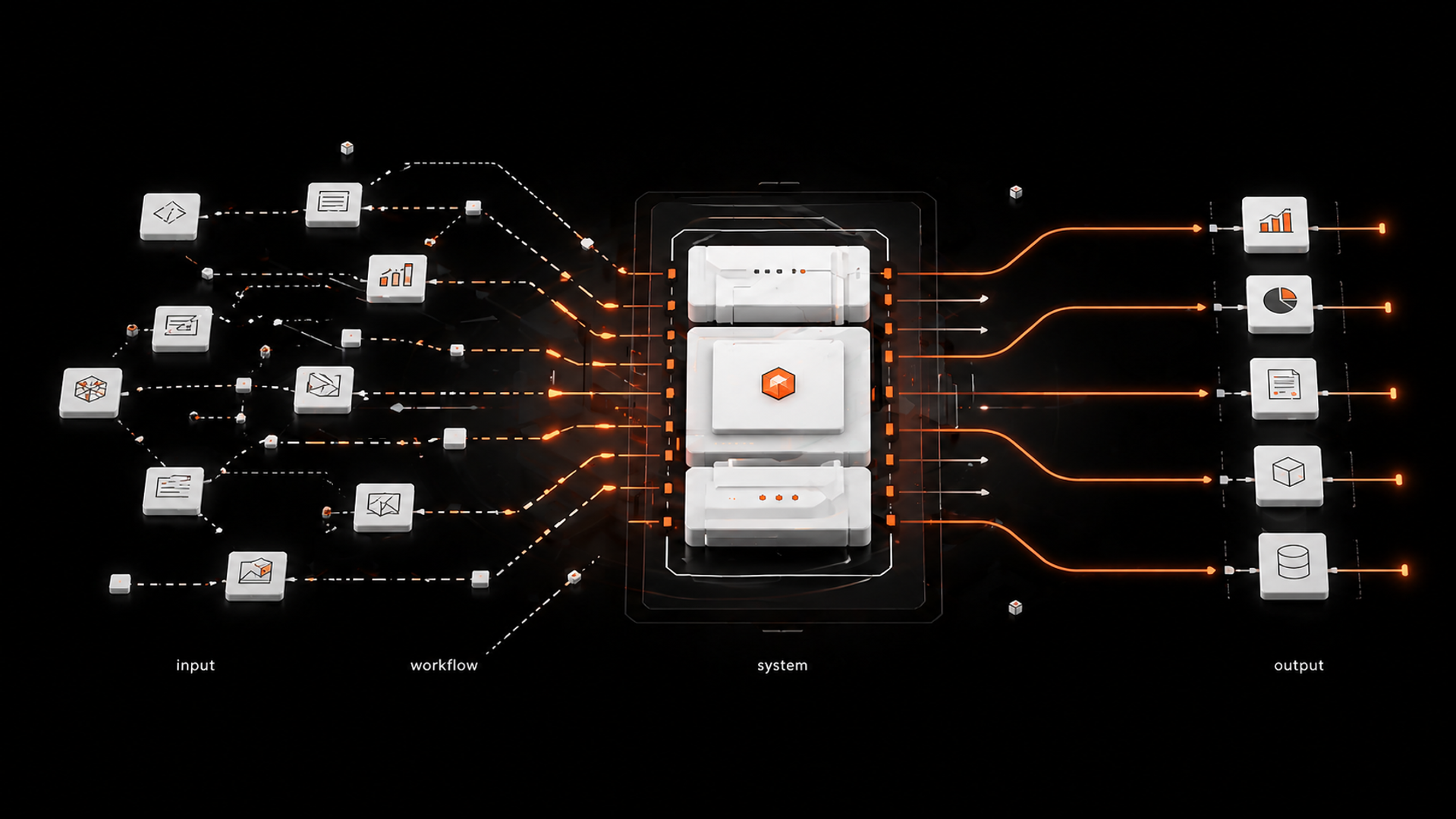
Gemini Enterprise is worth paying attention to if your business needs governed agent workflows that move across systems, not just a chat tool that drafts text. That is the real buying question.
Google is no longer selling only a model. It is packaging agent development, orchestration, access control, and governance into one enterprise platform. That changes the decision from “Which AI tool is best?” to “Which operating system for AI work do we want?”
For business owners, operators, and developers, that matters. If your team needs to automate repeatable work across apps, approvals, and data sources, Gemini Enterprise may be relevant. If you mainly need faster writing, search, or one-off help, a smaller stack of best AI tools for business will often be cheaper, simpler, and easier to control.
The contrarian view: most teams do not need an agent platform yet
The market is moving fast, and vendor messaging makes it sound like every team should jump straight to agents.
That is not the right starting point.
Most organizations are still struggling with basic questions:
- Which workflows should be automated first?
- Where does human review still matter?
- Which data can an AI system safely access?
- Who owns the process when the tool makes a mistake?
Until those answers are clear, buying a full agent platform can create more complexity than value. In other words, Gemini Enterprise may be powerful, but power is not the same as readiness.
The practical lens is simple: if you need a governed system for AI execution, this is worth a look; if you need isolated productivity gains, start smaller.
What Gemini Enterprise actually is
Google’s new Gemini Enterprise offering combines several pieces:
- a Gemini Enterprise app for teams to discover, create, share, and run agents
- an agent platform for building and scaling workflows
- orchestration and governance features
- access to models and development tools inside one environment
The big shift is that Google is treating AI as an operational layer, not just a model layer.
That is important because many companies have ended up with a pile of disconnected AI tools:
- one for writing
- one for meeting notes
- one for support drafts
- one for internal search
- one for developer assistance
That stack can work, but it creates fragmentation. Different interfaces. Different permissions. Different logs. Different buying decisions.
Gemini Enterprise is trying to unify those pieces around agents that can do multi-step work.
When an agent platform beats a collection of AI tools
A platform wins when the work is not just “generate output,” but “complete a process.”
That usually means:
- tasks span multiple systems
- steps must happen in a fixed order
- approvals are required
- audit trails matter
- access permissions are sensitive
- the work repeats often enough to justify setup
Examples:
- route customer requests from inbox to CRM to support queue
- extract contract terms, flag risk, and send for review
- gather sales notes, update records, and draft follow-ups
- triage internal requests and assign the right owner
- monitor a process and trigger actions when conditions change
In those cases, a collection of point tools can become hard to manage. A platform with orchestration and governance may be the cleaner choice.
When a smaller stack still wins
A smaller stack is better when:
- the workflow is still changing
- the team is experimenting
- only one department needs the tool
- the task is mostly content generation
- the business does not yet have strong process discipline
- the cost of setup will outweigh the benefit
This is where many companies should stay for now.
If your team does not have clear workflows, an agent platform can automate the wrong process faster. That is not transformation. That is expensive confusion.
For many buyers, the better path is:
- define the workflow
- simplify the process
- automate the highest-friction step
- add governance only when the process proves repeatable
That is often a better route than starting with a platform purchase.
A practical buying framework for Gemini Enterprise
Use this five-step test before you adopt any new AI product, including Gemini Enterprise.
1. Start with the workflow, not the model
Ask: what business process are we trying to improve?
Good candidates are high-volume, repeatable, and rules-based with some judgment.
If you cannot describe the workflow clearly, you are not ready to buy an agent platform.
2. Map the systems the agent would need to touch
Ask: what apps, data sources, and approvals are involved?
If the answer is “just one tool,” you may not need a platform.
If the workflow crosses email, CRM, docs, ticketing, and internal systems, platform value rises.
3. Define the control points
Ask: where must a human approve, edit, or intervene?
This matters because agentic AI is only useful when it is safe to delegate. Governance is not a nice-to-have. It is the product.
4. Test reliability on one narrow use case
Do not evaluate Gemini Enterprise on broad promises.
Pick one workflow with clear boundaries. Then test:
- quality of output
- failure modes
- logging and traceability
- permission handling
- ease of maintenance
- how much staff training is required
5. Compare total operating cost, not feature count
The real comparison is not feature lists. It is:
- setup time
- admin overhead
- integration effort
- vendor lock-in
- training cost
- security review burden
- change management effort
A “simple” tool can be cheaper even if it has fewer features. A platform can be worth it even if it costs more, but only when it replaces enough manual coordination.
What this means in practice
For business leaders, Gemini Enterprise signals a new phase in the AI software market.
The buying decision is shifting from isolated tools to agent operating environments.
That matters because the winning product is no longer the one with the flashiest demo. It is the one that can safely sit inside real work:
- with permissions
- with oversight
- with traceability
- with integration into existing systems
For operators, this is a warning and an opportunity.
The warning: do not buy before you have a process.
The opportunity: if you already know which workflows are bottlenecks, an agent platform may reduce coordination work that point tools cannot handle well.
For developers, the key question is architectural. Do you want a loose set of AI APIs and apps, or a governed platform with opinions about orchestration, identity, and deployment? There is no universal answer. It depends on your maturity, your stack, and how much control you need.
This is exactly where a structured implementation partner can help. Kumi Studio’s AI consulting services are designed to help teams decide what to adopt, what to avoid, and how to turn AI into working systems rather than disconnected experiments.
Is Gemini Enterprise worth using for a business team?
Yes, but only for the right team.
Gemini Enterprise is worth attention if you are:
- building agent workflows across multiple systems
- operating in a regulated or security-sensitive environment
- trying to standardize AI use across departments
- ready to invest in governance and process design
It is less compelling if you are:
- still exploring basic AI use cases
- mainly looking for better writing or summarization
- not ready to define ownership and controls
- hoping the tool itself will fix broken workflows
So the answer is not “yes” or “no.” It is “yes, if your operating model is ready.”
How to compare this tool with alternatives
Do not compare Gemini Enterprise only against other AI vendors.
Compare it against your current operating reality:
- a set of smaller AI tools
- internal scripts or workflows
- manual human processes
- workflow automation platforms
- custom-built internal tools
Then ask:
- Which option is fastest to deploy?
- Which one is easiest to govern?
- Which one creates the least operational drag?
- Which one fits the way our team already works?
In some cases, the strongest choice will still be a smaller stack plus careful process design. In other cases, a platform like Gemini Enterprise will be the better long-term fit.
If your team needs help building that comparison, Kumi Studio can support both strategy and build work through AI development services.
A simple decision rule
Use this rule of thumb:
- choose a smaller stack if you need speed, flexibility, and low cost
- choose Gemini Enterprise if you need governed, multi-step agent workflows at scale
That is the real tradeoff.
Key takeaways
- Gemini Enterprise is not just another AI tool; it is a platform for governed agent workflows.
- Most teams should not buy a platform until the process is clear and repeatable.
- The best choice depends on workflow complexity, governance needs, and integration depth.
Related reading
If you are evaluating Gemini Enterprise or any other new AI product, Kumi Studio can help you turn the buying question into an implementation plan. Contact us if you want a grounded view of what to adopt, what to skip, and how to build the right system for your team.