
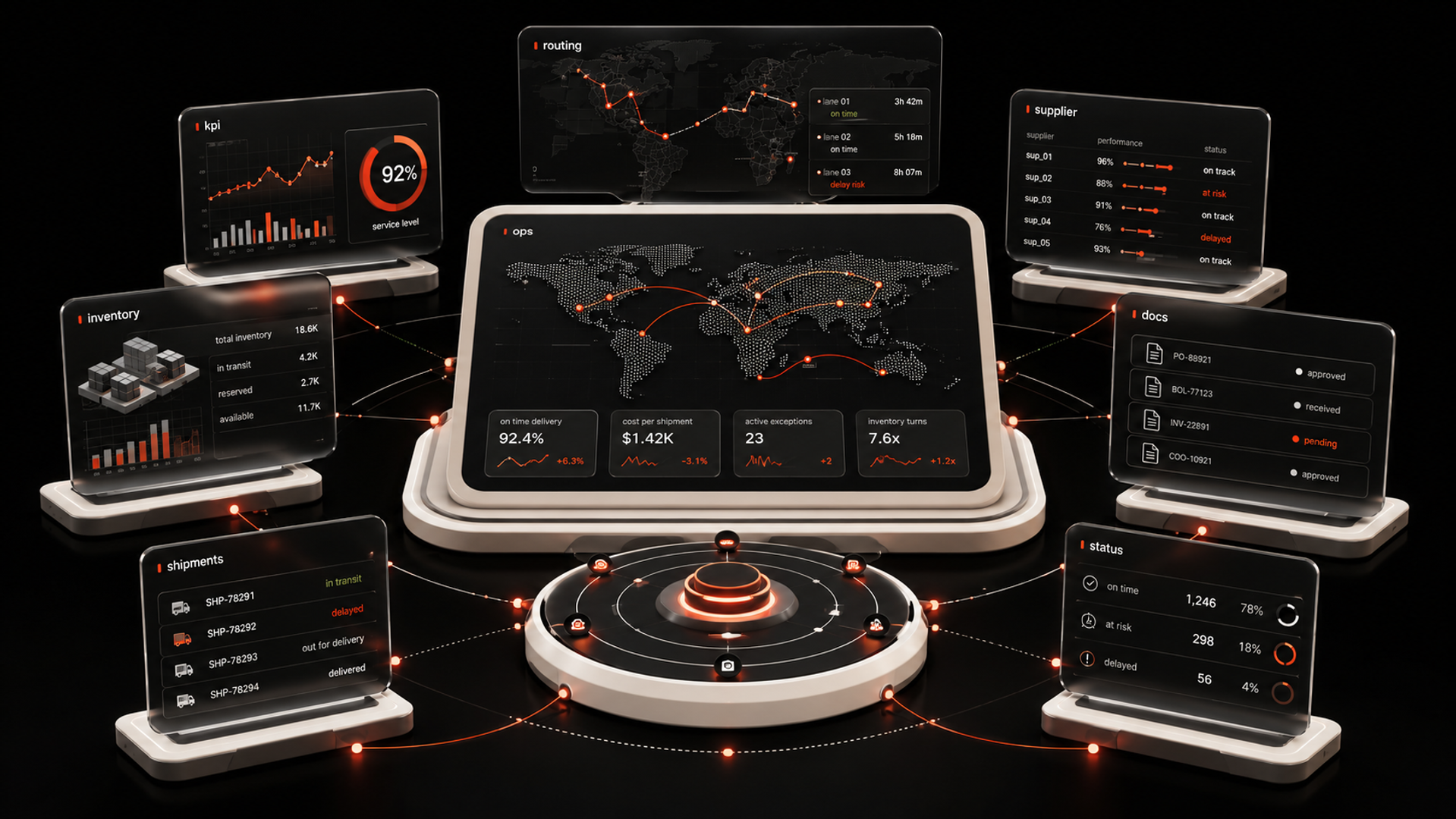
A logistics manager sees the same problem every morning: a shipment is delayed, the ETA changed, three systems disagree, and someone has to chase updates across email, TMS, WMS, and supplier messages. Nothing is “broken” in a dramatic way. The friction is smaller than that. It is hidden in exceptions, handoffs, and rework.
That is why many supply chain AI projects underperform. They try to automate everything at once, or they start with a model problem when the real issue is workflow friction. The fastest AI ROI in supply chain and logistics comes from removing one costly bottleneck at a time, especially where manual exception handling slows cycle time and burns operator hours.
For teams looking at ai consulting services, the key question is not “What can AI do?” It is “Where does work stall, and what is that stall costing us?”
The real ROI problem in supply chain operations
Supply chain teams are not short on data. They are short on coordination.
Orders move through planning, procurement, warehouse operations, transportation, customer service, and finance. Each handoff creates room for delay. When a shipment exception occurs, people spend time finding context, checking status, rewriting messages, and updating systems. That is the kind of work AI can improve quickly.
This matters now because most teams are expected to do more with fewer people. Headcount is not keeping pace with operational complexity. At the same time, many workflows still depend on manual exception handling across disconnected tools.
That is where AI creates value first:
- reducing time spent on routine exception work
- shrinking rework from bad or incomplete data
- speeding up coordination across teams and partners
- making decisions faster with better context
This is also why ai strategy consulting should begin with workflow analysis, not model selection. If the bottleneck is unclear, the ROI model will be weak.
Where workflow friction hides the fastest ROI
The best AI opportunities are usually not the most visible ones. They are the ones with frequent interruptions and high coordination cost.
In supply chain and logistics, these are the usual friction points:
1. Exception handling
Delayed shipments, missing ASNs, damaged goods, inventory mismatches, customs issues, and carrier changes all create exception work. The same question gets answered repeatedly: What happened? Who owns it? What is the next step?
AI can help summarize the case, classify the issue, pull relevant records, and suggest the next action.
2. Handoffs between systems and teams
Planning may live in one tool, transportation in another, and customer updates in a third. People bridge the gaps manually. That creates delays and version conflicts.
AI can reduce this coordination cost by extracting information, drafting updates, and routing tasks to the right team.
3. Rework from incomplete data
When data arrives late or in the wrong format, operators spend time fixing it. Developers know this pain well: bad inputs create brittle workflows.
AI can normalize unstructured documents, interpret message threads, and flag missing information before it causes downstream work.
4. Decision bottlenecks
Many decisions are routine but still require human review because the context is scattered. That slows response time.
AI can package the context for a human decision-maker so the review becomes fast instead of investigative.
The lesson is simple: if a task happens often, depends on scattered information, and needs repeated human judgment, it is a strong candidate for AI.
A practical ROI framework for AI consulting services
A useful ai roi consulting approach should be built around one simple question: where does friction cost the most per month?
Use this four-step framework.
Step 1: Map the workflow, not the org chart
Start with one process end to end, such as shipment exceptions, order changes, or supplier issue resolution.
Track:
- trigger event
- systems touched
- people involved
- number of handoffs
- average cycle time
- where work gets paused or repeated
This creates a real view of friction.
Step 2: Score the bottlenecks
Rank each bottleneck by three factors:
- frequency: how often it happens
- effort: how much human time it consumes
- impact: how costly the delay or error is
The highest score is usually not the most glamorous use case. It is the one that is repetitive, annoying, and expensive.
Step 3: Define the AI role
Do not ask AI to “fix operations.” Define the task narrowly.
Good AI roles include:
- classify an exception
- extract key fields from emails or PDFs
- summarize case history
- suggest next best action
- draft an update for review
- route the workflow to the right owner
This is where ai consultancy for business becomes practical. The value comes from specific workflow design, not vague automation promises.
Step 4: Prove ROI with operational measures
Measure the outcome in business terms, not model terms.
Track:
- cycle time
- exception resolution time
- number of manual touches
- percentage of cases resolved without escalation
- rework volume
- labor hours saved
- service-level impact
If the AI improves the workflow but not the metrics, it is not yet creating business value.
What this means in practice
The most effective AI projects in supply chain do not replace the operating model. They make it less fragile.
A practical example is exception management. Today, a delayed shipment may trigger five messages, two system checks, one spreadsheet update, and a manager approval. AI can turn that into a single workflow:
- detect the exception
- gather the relevant records
- summarize the issue in plain language
- recommend the likely next action
- draft the communication for human approval
- log the result back into the system
This does not eliminate the human. It removes the repeated investigative work around the human.
That distinction matters for ROI. If the goal is full automation, teams often wait too long or overbuild. If the goal is workflow acceleration, value appears faster.
This is also why modern AI platforms matter. New enterprise AI systems are making it easier to connect models, agents, and governance to real work. But tools alone are not strategy. The workflow still has to be worth improving.
For most teams, the right starting point is not a broad transformation program. It is a narrow operating problem with clear cost and frequent repetition.
How to choose the first AI use case
If you are deciding where to start, use this filter.
Choose the use case that has:
- high volume
- clear business owner
- repeatable steps
- measurable delay or rework
- enough data to support decision-making
- a workflow you can change without rewriting the whole stack
That is often one of three areas:
- shipment or order exceptions
- document and message processing
- internal coordination and case handling
These use cases tend to create value first because they sit close to daily operations. They are not dependent on a major platform replacement. They can often be layered into existing systems.
This is the right lens for ai consulting services: not “What is the most advanced use case?” but “Where can we reduce friction quickly and safely?”
Key takeaways
- The fastest AI ROI in supply chain comes from removing workflow friction, not automating everything at once.
- Start with exceptions, handoffs, and rework, because that is where time and coordination cost add up fastest.
- Measure success in cycle time, manual touches, and resolution speed, not model novelty.
Related reading
If your supply chain team is dealing with repeated exceptions, slow handoffs, or too much manual coordination, Kumi Studio can help you identify the right workflow, build the ROI case, and turn AI into a working system. Start with our AI Consulting Services page or contact us to discuss the bottleneck you want to fix first.