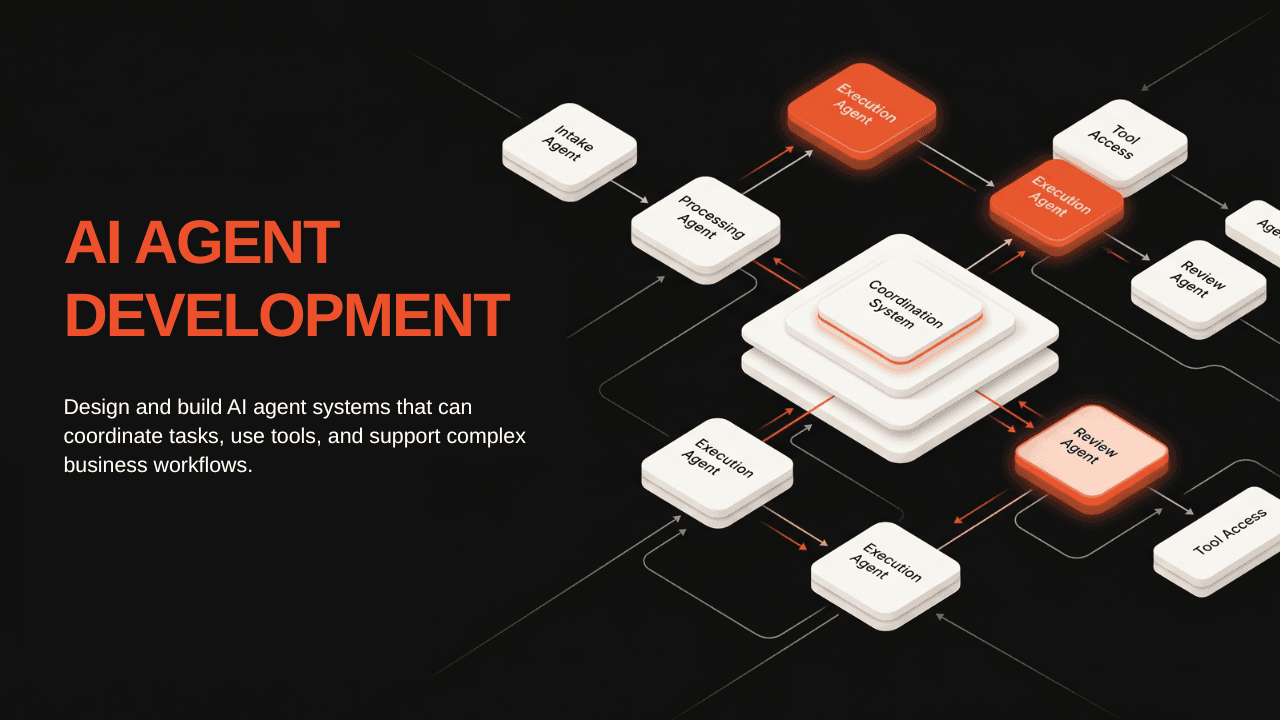
Design and build AI agent systems that can coordinate tasks, use tools, and support complex business workflows.
What are AI agent development services for logistics?
AI agent development is the work of building systems where AI does more than generate a single response.
An agent-based system may:
- interpret an input or request
- decide which step should happen next
- use one or more tools
- gather or retrieve context
- hand work to another function or stage
- support human review when needed
- continue through a sequence until the workflow reaches an outcome
This becomes especially useful in workflows where work cannot be completed by a single model output alone.
What is a multi-agent system in supply chain operations?
A multi-agent system uses multiple specialized agents or coordinated roles inside the workflow.
Each agent may focus on a different part of the process, such as:
- intake and classification
- research and retrieval
- validation and policy checks
- drafting or output generation
- tool execution
- review and escalation
The value of a multi-agent system is not in having more agents. The value is in breaking complex workflows into controlled, understandable parts that can coordinate well.
At Kumi Studio, we only recommend multi-agent architecture when the business process actually benefits from it. In many cases, simpler automation is still the better answer.
When do logistics teams need AI agent development?
AI agent systems are most useful when:
- the workflow has multiple steps and decision points
- the system needs to work across several tools
- context needs to be gathered and passed through the process
- the work includes routing, validation, and execution stages
- the business wants more autonomy than a basic assistant can provide
This often applies to operational workflows, internal task systems, support processes, document-heavy sequences, sales operations, internal assistants, and process layers where the work needs coordination rather than just output generation.
What do Kumi Studio AI agent development services include?
Agent workflow design
We map the business workflow first, then determine where agents should operate inside it. That includes responsibilities, handoffs, tool usage, escalation points, and boundaries.
Single-agent system design
Some workflows do not need multiple agents. A single well-scoped agent with clear controls may be enough. We help define when that is the right architecture.
Multi-agent system planning
When the workflow is more complex, we design multi-agent systems with specialized roles and clearer orchestration. The point is to reduce complexity in the process, not add complexity for its own sake.
Tool integration and orchestration
Agent systems are most useful when they can work across real business tools. We help connect agents to internal systems, external platforms, APIs, data sources, and workflow actions where it makes sense.
Reliability and control design
A business-ready agent system needs guardrails. We design around approvals, exception handling, action boundaries, fallback behavior, logging, and human review.
How are AI agents different from basic automation in logistics?
Basic automation follows rules.
AI agents are useful when the workflow has ambiguity, variable inputs, changing context, or a sequence of actions that cannot be handled with fixed rules alone.
For example:
- A fixed automation can send a form submission into a CRM.
- An AI agent can classify the lead, gather context, route it correctly, draft a follow-up, and escalate special cases.
The difference is not just "more intelligence." It is the ability to operate across a chain of decisions and actions.
Still, this does not mean every workflow needs agents. A major part of good consulting is knowing when agent architecture is justified and when it is unnecessary.
How does Kumi Studio build AI agent systems?
1. Start with workflow complexity
We identify where the workflow truly requires coordinated decisions, context handling, and tool use.
2. Define agent roles clearly
Each agent or stage needs a clear responsibility. Good multi-agent systems are easier to reason about because the work is structured, not blurred.
3. Connect agents to the right tools
Agent value often comes from orchestration. We design around the systems the business already uses so the agent workflow can act inside real operations.
4. Build for control, not just autonomy
Business-ready agents need boundaries. We define where the system can act automatically, where it should pause, and where human review is still necessary.
5. Improve the workflow over time
Agent systems should become more reliable through better orchestration, better handoffs, and clearer exception logic. We treat them as operational systems, not novelty features.
Why choose Kumi Studio for AI agent development?
Kumi Studio approaches agents from a workflow and implementation perspective.
That matters because many agent projects fail for predictable reasons:
- the workflow is not well defined
- the system has too much autonomy in the wrong places
- the integration layer is weak
- the architecture is more complex than the business problem requires
We help businesses avoid those mistakes by focusing on:
- workflow fit
- clear system roles
- practical orchestration
- tool integration
- real operational controls
Where do AI agent systems create value in logistics?
Internal operations
Agent systems can support internal task handling, coordination, workflow routing, and request processing across teams and systems.
Sales and revenue workflows
Agents can help qualify leads, enrich context, prepare drafts, route follow-ups, and support multi-step sales operations.
Support and service workflows
Agent systems are useful when support requires retrieval, classification, drafting, escalation, and handoff between automated and human stages.
Research and analysis processes
Where workflows involve gathering information, validating it, summarizing findings, and moving through decision steps, agent-based designs can be useful.
Cross-system orchestration
If a workflow spans several tools, APIs, and actions, agent design can help coordinate those stages more intelligently than rigid automation alone.
What does AI agent development mean in practice for logistics teams?
In practice, the best agent systems do not feel magical. They feel structured.
A strong agent workflow should make the business process easier to run by:
- reducing manual coordination
- improving consistency across steps
- handling context more intelligently
- limiting unnecessary human effort
- keeping decisions visible and reviewable
That is the real test of a good system.
If the workflow becomes harder to understand, harder to control, or harder to maintain, the architecture is wrong. Good agent development should simplify operations, not impress people with complexity.
What are the key takeaways on AI agent development?
- AI agent development is useful when a workflow needs coordinated decisions, tool use, and multi-step execution.
- Multi-agent systems make sense only when the process genuinely benefits from specialized stages or roles.
- Reliable agent systems depend on orchestration, integrations, controls, and workflow fit, not just model capability.