
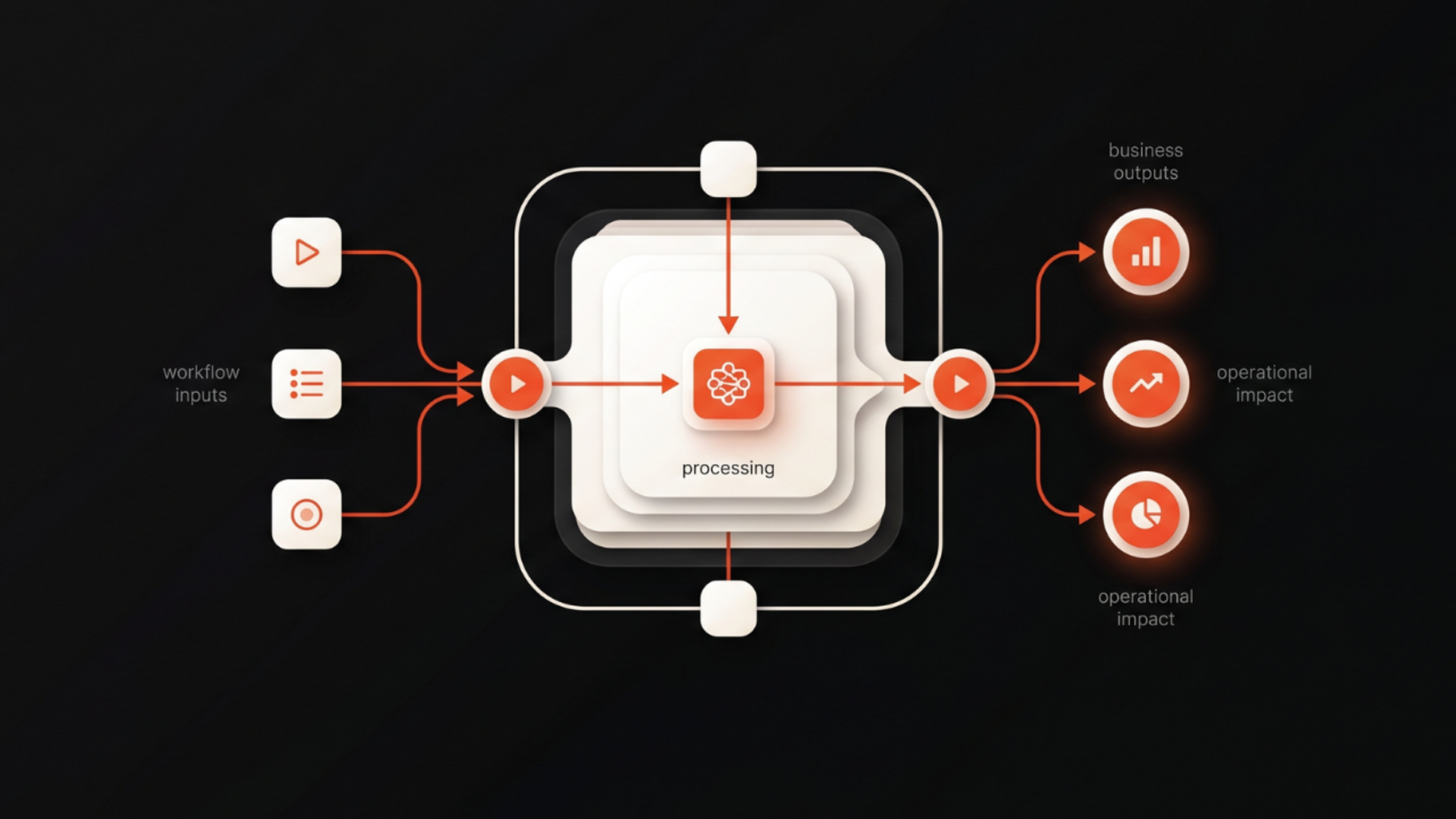
Most AI programs do not fail because the technology is weak. They fail because no one can explain where the money shows up.
That is the core problem behind many stalled pilots. Teams build demos, leaders ask for ROI, and the conversation gets vague fast. If you want funding, you need more than an AI idea. You need a business case tied to a real workflow, a clear operating owner, and a measurable outcome.
This article shows how to build that case. You will learn how to think about AI ROI in practical terms, where to start with AI strategy, and how to choose the first use case that is most likely to create value. If you are evaluating ai roi consulting or comparing ai consulting services, this is the right lens: business value first, technology second.
The real business problem: AI spend without operational payback
Many companies are not short on ideas. They are short on proof.
A founder may see customer support automation, sales enablement, document processing, or internal knowledge search as promising. An operator may see hours of manual work buried in handoffs and approvals. A developer may see the technical path clearly. But leadership still asks the same question:
What changes in the business if we do this?
That question matters because AI is not just software. It affects workflows, roles, data, controls, and decision-making. If the business case only says “productivity will improve,” it is too vague to fund.
A funded AI strategy usually does three things:
- Identifies a workflow with real cost, delay, or leakage
- Shows how AI changes that workflow in measurable terms
- Connects the change to revenue, margin, risk, or capacity
That is how AI moves from experiment to operating model.
How businesses measure AI ROI
AI ROI should not be measured only by model accuracy or demo quality. It should be measured by business outcomes that show up in day-to-day operations.
The simplest way to think about it is:
ROI = value created - cost to implement and operate
The value side can include:
- Time saved in a high-volume workflow
- Faster turnaround time for customer or internal requests
- Lower error rates or rework
- More leads handled without adding headcount
- Better conversion rates in sales or marketing
- Reduced compliance or operational risk
- Higher employee capacity for higher-value work
The cost side should include:
- Strategy and discovery work
- Data preparation
- Integration with existing systems
- Model or vendor costs
- Change management and training
- Ongoing support, monitoring, and governance
A strong business case does not need perfect math. It needs credible math. Leaders know early estimates are imperfect. What they want to see is a sensible path from workflow pain to business value.
Where to start with AI strategy
The best place to start is not with the most advanced AI use case. It is with the workflow that is both valuable and tractable.
That usually means looking for work that is:
- Repetitive
- High volume
- Rules-based with some judgment
- Buried in manual coordination
- Easy to measure before and after
Examples include:
- Customer support triage
- Proposal or RFP drafting
- Invoice or claims processing
- Sales qualification and account research
- Internal knowledge retrieval
- Reporting and analyst support
- Compliance review workflows
In practice, the best starting point is often not a dramatic transformation. It is a process where AI can remove friction fast, prove value quickly, and fit inside existing systems.
That is why many ai strategy consulting engagements begin with workflow mapping instead of model selection. If you start with the use case, you can tie it to the business. If you start with the model, you often end up with a pilot that nobody owns.
A step-by-step framework for building a funded AI business case
1) Pick one business problem, not a platform idea
Do not ask, “How can we use AI?”
Ask, “Where are we losing time, money, or quality today?”
Good business cases start with a pain point:
- Too many manual handoffs
- Slow customer response times
- Costly document review
- Inconsistent sales execution
- Fragmented knowledge across teams
The problem should be visible enough that leaders recognize it immediately.
2) Map the workflow from start to finish
Do not stop at the task. Look at the entire flow.
Example: If the issue is sales proposal creation, the workflow may include:
- Intake of client requirements
- Searching past proposals
- Drafting the first version
- Internal review
- Approval and customization
- Final delivery
This matters because AI often creates value at the handoff points, not just inside the task itself.
3) Identify the measurable business outcome
Translate the workflow pain into a business metric.
Examples:
- Reduce average response time from days to hours
- Cut manual review time per case
- Increase throughput without increasing headcount
- Improve conversion on qualified leads
- Reduce rework in document-heavy processes
This is where many business cases get stronger. Leaders fund outcomes, not abstract potential.
4) Estimate the economic impact
Use simple assumptions.
If a workflow saves 15 minutes per case across 2,000 cases a month, what does that mean in labor capacity? If faster response improves conversion, what is the likely effect on pipeline? If error reduction lowers rework, what cost does that remove?
You do not need a complex financial model at the beginning. You need a clear and defensible logic chain.
5) Define what must be true for the use case to work
This is the part many teams skip.
An AI use case may require:
- Clean enough data
- A stable process
- Human review for exceptions
- Integration with CRM, ERP, or ticketing tools
- Clear governance and ownership
This is where ai consulting services add value. Good consultants do not just propose AI. They identify what has to be true for the value to show up in operations.
6) Choose a pilot that can become a system
A pilot should not be a side project.
It should be designed to become part of the workflow if it works. That means:
- Clear owner
- Clear users
- Clear adoption path
- Clear success metrics
- Clear next step after the pilot
If a pilot cannot become part of the operating process, it is only a test. It is not a business case.
What this means in practice
For business owners, the question is not whether AI is interesting. It is whether AI changes economics.
For operators, the question is not whether the demo works. It is whether the workflow becomes faster, cleaner, and easier to manage.
For developers, the question is not whether the architecture is elegant. It is whether the system fits the real constraints of the business.
That is why the strongest AI programs are rarely the most complex. They are the most operationally grounded.
At Kumi Studio, we see this repeatedly in ai consultancy for business engagements. The companies that get traction are not the ones chasing broad transformation language. They are the ones that define one workflow, one owner, one metric, and one path to production.
This is also where strategy and implementation have to meet. A useful AI business case should point directly to the build decision: what to automate, what to assist, what to leave human, and how to measure the impact after launch.
If you are comparing approaches, our AI Consulting Services page shows how we help teams turn AI ideas into working systems.
Common mistakes that weaken AI ROI cases
Mistake 1: Estimating value from vague productivity gains
“Teams will save time” is not enough.
Say where the time is saved, how often, and what changes as a result.
Mistake 2: Ignoring adoption friction
Even a strong use case fails if people do not trust it, use it, or know where it fits in the process.
Mistake 3: Treating the pilot as the finish line
A pilot that is not designed for production rarely creates ROI.
Mistake 4: Starting with the most exciting use case
The best first use case is often boring, repetitive, and easy to measure.
Mistake 5: Underestimating data and integration work
AI value depends on the systems around it. Data quality, access, governance, and workflow integration matter as much as the model itself.
This is why many leaders choose an experienced partner for ai consulting services rather than trying to assemble a business case in isolation.
Key takeaways
- AI ROI is measured in workflow outcomes, not in demo quality or vague productivity claims.
- The best first use case is usually a repetitive, high-volume process with clear business metrics.
- A funded AI business case needs an owner, a workflow map, a value estimate, and a clear path to production.
Related reading
Final thought
AI should not be funded because it is new. It should be funded because it changes how work gets done.
If you need help turning an AI idea into a business case leaders will approve, Kumi Studio can help you evaluate the workflow, define the ROI, and build the implementation path. Start with our AI Consulting Services page or contact us to discuss the right first use case.